




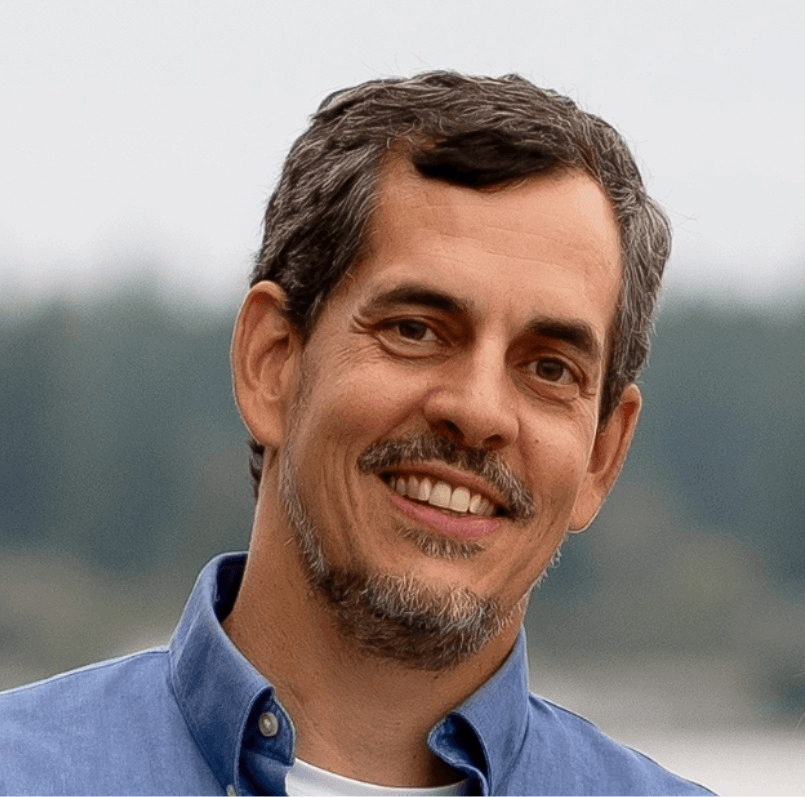
Today we’d like to introduce you to Richard Benson.
Richard, we appreciate you taking the time to share your story with us today. Where does your story begin?
I got into this work sideways, which is probably why I’m still in it.
I started as a middle school Spanish teacher. I liked the kids and I liked teaching, but it didn’t take long to see that what most of them needed had nothing to do with conjugating verbs. They were carrying things home and back again every day, and I could see it, and I couldn’t do anything about it from the front of a classroom. So I left and went to work at a wilderness school.
I learned more from those kids than at any other point in my life. They were angry, scared, and sharp as anything — they could spot an adult who wasn’t being straight with them from a hundred yards. You couldn’t perform your way through that job. You had to actually be present, and you had to be honest, or they’d dismiss you and they’d be right to.
I should say I didn’t get there on a clear path. For a stretch of my twenties I was unfocused and running with a crowd that made it easy to stay that way. I tried on a lot of careers looking for something that felt like it mattered, and none of them did. It took my own struggles to understand what I actually wanted, which was to help people and to be around while they figured out who they could become. Once I knew that, the rest was just logistics. I went back to school after ten years for my master’s in social work and pursued my clinical license.
After that I went everywhere on purpose. Case management. Residential treatment. Outpatient clinics. Hospitals. The military. I wanted to see the system from the inside at every level, because I’d watched too many families get lost in it — handed a phone number and a brochure and told good luck. Knowing how those places actually work, what they can and can’t do, and who to call is a large part of what I offer people now.
Today I run a private practice specializing in trauma and addiction, working with individuals and families.
What I’ve come to believe, after twenty-plus years, is that almost everyone I meet is doing the same thing: looking for relief. People who are desperate look for answers wherever they can find them. Some go to a doctor for medication. Some come to therapy for insight. Some turn to religion. Some throw themselves into diet and exercise, or travel, or a new city, or a new relationship. And some find relief in drugs, alcohol, gambling, pornography, endless scrolling — things we call maladaptive, though every one of them works at first. That’s the whole problem. They work.
Underneath all of it is the same thing: someone trying to get away from pain or fear. And you cannot get away from it. You can only go through it. That’s the part I help people do — not the escape, but the return. Naming what happened, owning what’s been maintaining it, and rebuilding something that actually holds.
People heal when movement occurs. That’s true for the kids at the wilderness school, it was true for me, and it’s true for every family that walks through my door.
Would you say it’s been a smooth road, and if not what are some of the biggest challenges you’ve faced along the way?
No, it has been anything but smooth. And I think that matters, because a lot of people sitting across from me assume the person in the other chair figured it out cleanly. I didn’t. High school was mostly partying. I was smart enough to keep my grades up while I did it, which was the worst possible outcome — I got the message that I could have both, and I carried that message into college. My first couple of years there I actually put my head down and worked hard. Then I started partying again, and things came apart slowly enough that I could tell myself they weren’t. That’s how it usually goes. Nobody wakes up one day at the bottom. You descend one reasonable-seeming decision at a time.
By my last semester I was begging a professor for a passing grade so I wouldn’t fail a class outright. I knew that if I failed it, I wasn’t coming back for another semester — I’d have been done. By some grace, I graduated.
In the fall of 1996, less than six months after graduation, I got a DUI. That closed doors. For a long stretch, employment meant whatever I could piece together, and I told myself that was just bad luck rather than a consequence. I floundered for about three years. I worked in restaurants, worked in entertainment, became a commercial diver.
I tried the recovery thing during those years and I wasn’t good at it. I want to be clear about what I mean by that, because I think it’s the most useful part of my story. I went. I said the right things. I was not honest — not with anybody in the rooms, not with my therapists and not with myself. And you cannot heal in a room you’re lying in. It doesn’t work no matter how good the room is.
It took about five years after graduating, and what felt like crashing and burning, before I actually asked for help and was ready for it. I found a therapist who was willing to work with me and, more importantly, who I was finally willing to be honest with. He once told me I was one of the most confused and difficult patients he’d ever worked with. He meant it, and he was right, and he stayed anyway. That’s the part I think about most now — he didn’t manage me or hand me off. He held the line and kept showing up and so did I.
He’s also the one who eventually said I should stop trying to fix my life from inside my life and go do something completely different. He suggested a wilderness school. I have no idea if he knew what he was setting in motion. It changed the course of everything.
So when someone tells me they’ve tried treatment and it didn’t work, I don’t argue with them and I don’t flinch. I ask what they were honest about. Almost always, that’s the whole thing. Shame survives on silence, and it will keep you circling the same pain for a decade if you let it. I know that because I did it.
The struggle wasn’t the drinking, or the DUI, or the dead-end jobs. Those were symptoms. The struggle was that I would not tell the truth about what I was actually running from. Everything that got better, got better after that changed.
Thanks for sharing that. So, maybe next you can tell us a bit more about your business?
Benson Family Services is a private practice in Gig Harbor. I do individual and family therapy, and I do family intervention work — the kind where a family has run out of options and needs someone in the room with them. I specialize in trauma and addiction, and specifically in where those two things meet. Most of the addiction I see isn’t a moral failure or a genetic accident. It’s a solution. It’s what somebody found that made the pain stop, and it worked, and that’s exactly why it’s so hard to give up. If you treat the substance and never touch what’s underneath it, you get abstinence for a while and then you get relapse, and the person concludes they’re the problem. They’re not. The treatment was incomplete.
What I’m probably best known for is a framework I developed called the ROAR Method ™. Recognize, Own, Answer, Rebuild.
Recognize is naming the pattern — not just what you do, but where you learned it. Own is the part people brace for, so I say it plainly: you didn’t choose the origin, but you do own the maintenance. What happened to you wasn’t your fault. What keeps happening is your responsibility. Those two things are both true, and holding them together is where change actually starts. Answer is testing the thought against evidence and then saying it out loud to another human being, because shame does not survive contact with air. It survives on silence. And Rebuild is landing on a truth your mind will actually accept — not an affirmation you don’t believe, but something digestible — and then acting on it until it’s real.
I put ROAR in front of clients every week, and I’ve published it openly on my blog because I’d rather it be useful than proprietary. I’m currently writing a book on it, with a second one planned that applies it to addiction — written so that peers can facilitate groups from it, without anyone having to stand up and introduce themselves with a label that reinforces the very shame we’re trying to dismantle.
A few things set the practice apart.
The first is range. I’ve worked in wilderness programs, residential treatment, outpatient clinics, hospitals, the military, and as a liaison to courts and schools. When a family calls me and says their son needs help and they don’t know where to start, I know what those places actually do, which ones are good, what they cost, and what happens when the insurance runs out. Families get handed a list of phone numbers all the time. I can tell you which numbers to call.
The second is that I work with the system, not just the person. Somebody can do excellent individual work and then walk back into a family running on the same broken patterns, and the family will pull them right back. Healing has to happen at the level of the system or it doesn’t hold.
The third is integration. That word gets used loosely, but I mean something specific by it: insight is not change. People have breakthroughs all the time — in therapy, in a hospital bed, on a retreat, in a religious experience, at rock bottom. The breakthrough is the easy part. Integration is the unglamorous work afterward of turning what you saw into how you actually live, and it’s where most people are left completely alone. That’s the work I want to be known for.
Brand-wise, what I’m most proud of is that I’ve never dressed this up. My website doesn’t promise anyone a peaceful journey to their authentic self. I tell people that treatment requires honesty, that they’ll have to look at themselves, and that they’ll have to follow through — and I say it before they hire me, because the people who want that are exactly the people I can help.
If your readers take one thing from this: relief is possible even for someone who has already tried and failed. Especially for them. I’ve sat with a lot of people who were convinced they were the exception, and they usually weren’t. They just hadn’t yet found a room they were willing to tell the truth in.
What were you like growing up?
Honestly? I had a great childhood. We weren’t wealthy, but I never went without. The only real financial strain I remember was keeping up with the Joneses, which in hindsight is a pretty good problem to have. I was an athlete. That was the center of everything for me — I loved competition, but more than that I loved what came with it. The team. The friendships. Having a place where I belonged and people who expected me to show up. I did well in school and I genuinely liked learning. And I have always, always loved music.
Then I got injured, and sports were taken away from me.
I don’t think I understood at the time what I’d actually lost. It wasn’t the games. It was the community. Overnight I went from having a built-in group of people and a built-in reason to be somewhere every day, to having neither. So what did I do? I started partying more, and I found community again through getting wasted.
Here’s the thing I want to be careful about, because it’s the part people get wrong: I didn’t fall in with bad people. I fell in with people who were looking for exactly what I was looking for. Connection. Belonging. Fun. A few hours off from the day-to-day. Those were good kids. They just weren’t equipped to catch somebody who was going off the deep end, and neither was I. We were all incapable youth having a good time.
I forgive those people now. That’s easy to say from where I’m sitting, but it wasn’t always. When I was still in my pain, it was much easier to point the finger outward — at them, at the injury, at my family, my upbringing, at bad luck — than to turn and look at myself. Externalizing is comfortable. It’s also a dead end, because you can’t change anything you’ve decided isn’t yours.
That’s the beauty of healing and then rebuilding. You get to go back and see it clearly. The kid I was wasn’t broken or bad. He lost the thing that gave him belonging and went looking for a replacement, and he found one that worked in the short term and cost him about a decade. That’s not a character flaw. That’s a human being doing what human beings do.
That’s the gift of an examined life. You stop needing anyone to be the villain, including yourself.
Contact Info:
- Website: www.bensonintervention.com